



The pursuit of restorative sleep has transitioned from a biological necessity to a primary pillar of preventative medicine. In the high-velocity landscape of 2026, where the boundaries between professional engagement and personal recovery have become increasingly porous due to ubiquitous neural integration and augmented reality interfaces, the ability to initiate sleep effectively is a critical skill for cognitive preservation. Sleep is not merely a passive state of rest but an active, highly regulated neurological process essential for glymphatic clearance, memory consolidation, and metabolic homeostasis.
When you investigate the physiological mechanisms of sleep, you encounter a complex interplay between the homeostatic sleep drive and the circadian alerting system. For many individuals, the transition from wakefulness to Stage 1 non-rapid eye movement (NREM) sleep is fraught with “sleep-onset latency”—a clinical term for the time it takes to transition from full wakefulness to sleep. Chronic delays in this transition can lead to systemic inflammation, reduced neuroplasticity, and a heightened risk for cardiovascular pathologies.
This guide provides an exhaustive analysis of the techniques, biological frameworks, and environmental adjustments required to master the art of falling asleep. We will examine the neurochemical pathways involved in the “sleep switch,” explore the efficacy of modern cognitive protocols, and analyze the latest bio-environmental data from 2025-2026 clinical trials. Whether you are navigating the challenges of shift-work sleep disorder or simply seeking to optimize your nocturnal recovery for peak performance, the following evidence-based strategies offer a roadmap to physiological tranquility. We recommend that you approach these techniques not as isolated “hacks,” but as components of a holistic neurological hygiene protocol designed to align your biology with the natural rhythms of the Earth.
Table of Contents
- The Neurobiology of Sleep Initiation
- Circadian Rhythm Alignment and Light Hygiene
- Cognitive Behavioral Strategies: The “Cognitive Shuffle” and Beyond
- Advanced Respiratory Protocols for Parasympathetic Activation
- The Thermodynamics of Sleep: Thermal Regulation Techniques
- Nutritional Neuroscience and Sleep-Promoting Compounds
- Environmental Ergonomics: Optimizing the Sleep Sanctuary
- The Role of Physical Activity and Muscle Relaxation
- Chronotherapy and Sleep-Wake Scheduling
- Pharmacological and Non-Pharmacological Interventions in 2026
- Addressing Psychological Barriers: Stress and Cortisol Management
- Wearable Technology and Biofeedback Integration
- Future Frontiers: Neuro-Acoustics and Electromagnetic Frequency Modulation
- Frequently Asked Questions (FAQ)
- Key Takeaways
1. The Neurobiology of Sleep Initiation
To understand how to fall asleep, you must first understand the “Sleep Switch” located within the hypothalamus. The Ventrolateral Preoptic Nucleus (VLPO) is a cluster of neurons that functions as the primary inhibitory center for wakefulness. When the VLPO is activated, it releases inhibitory neurotransmitters such as gamma-aminobutyric acid (GABA) and galanin, which effectively “turn off” the arousal centers in the brainstem.
The drive to activate this switch is governed by two primary forces: Adenosine accumulation and Melatonin secretion. Adenosine is a byproduct of cellular energy expenditure (ATP). Throughout your waking hours, adenosine levels rise in the basal forebrain, creating “sleep pressure.” When you reach a critical threshold, your brain signals the need for recovery. Conversely, melatonin, the “hormone of darkness,” is secreted by the pineal gland in response to declining light levels, signaling to the body that the biological night has begun.
Recent research in 2025 has highlighted the importance of the glymphatic system—the brain’s waste clearance mechanism—which becomes significantly more active during sleep. Efficient sleep initiation ensures that this “cerebral rinse” begins promptly, preventing the accumulation of beta-amyloid and tau proteins associated with neurodegenerative decline. When you apply techniques to fall asleep faster, you are essentially facilitating a smoother transition for the VLPO to inhibit the Reticular Activating System (RAS).
2. Circadian Rhythm Alignment and Light Hygiene
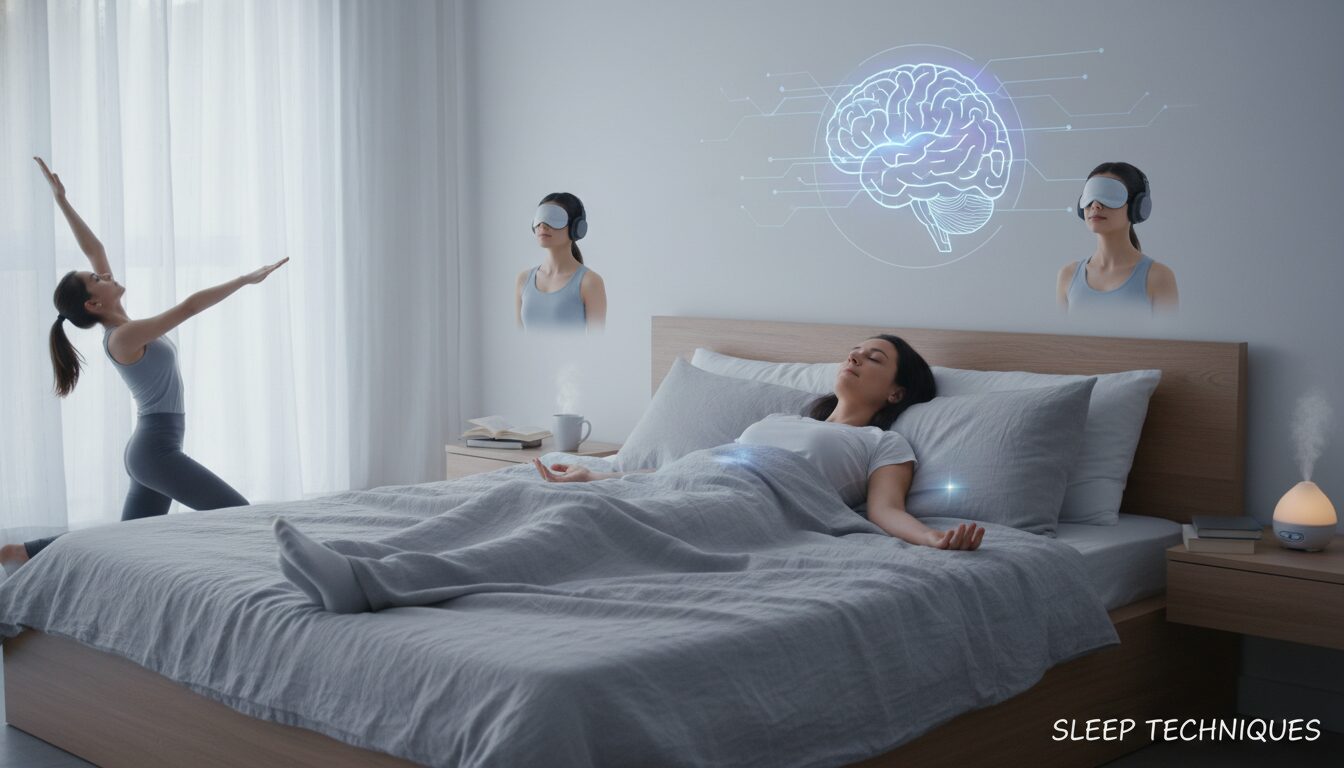
Your internal biological clock, or the Suprachiasmatic Nucleus (SCN), is highly sensitive to photic input. In the modern era, the prevalence of “blue light” (short-wavelength visible light) from OLED screens and high-intensity LED lighting has created a state of “digital twilight,” where the SCN is misled into believing it is mid-day.
To optimize your sleep onset, we recommend a strict light hygiene protocol. Scientific consensus suggests that blue light suppression should begin at least 90 to 120 minutes before your desired sleep onset. This allows the pineal gland to initiate the endogenous secretion of melatonin without interference. In 2026, many individuals use “Circadian-Aware” smart lenses or environmental lighting systems that automatically shift the spectrum toward warmer, amber tones (long-wavelength light) as evening progresses.
| Light Type | Wavelength (nm) | Effect on Melatonin | Recommended Use |
|---|---|---|---|
| Blue Light | 450-490 | High Inhibition | Daytime/Morning only |
| Green Light | 500-570 | Moderate Inhibition | Early Evening |
| Red/Amber Light | 620-750 | Minimal/No Inhibition | 2 Hours before Sleep |
Furthermore, the “Anchor Sleep” concept suggests that even on weekends, maintaining a consistent wake-up time is more critical for circadian stability than a consistent bedtime. This prevents “social jetlag,” a condition where your internal clock is out of sync with your social and professional schedule.
3. Cognitive Behavioral Strategies: The “Cognitive Shuffle” and Beyond
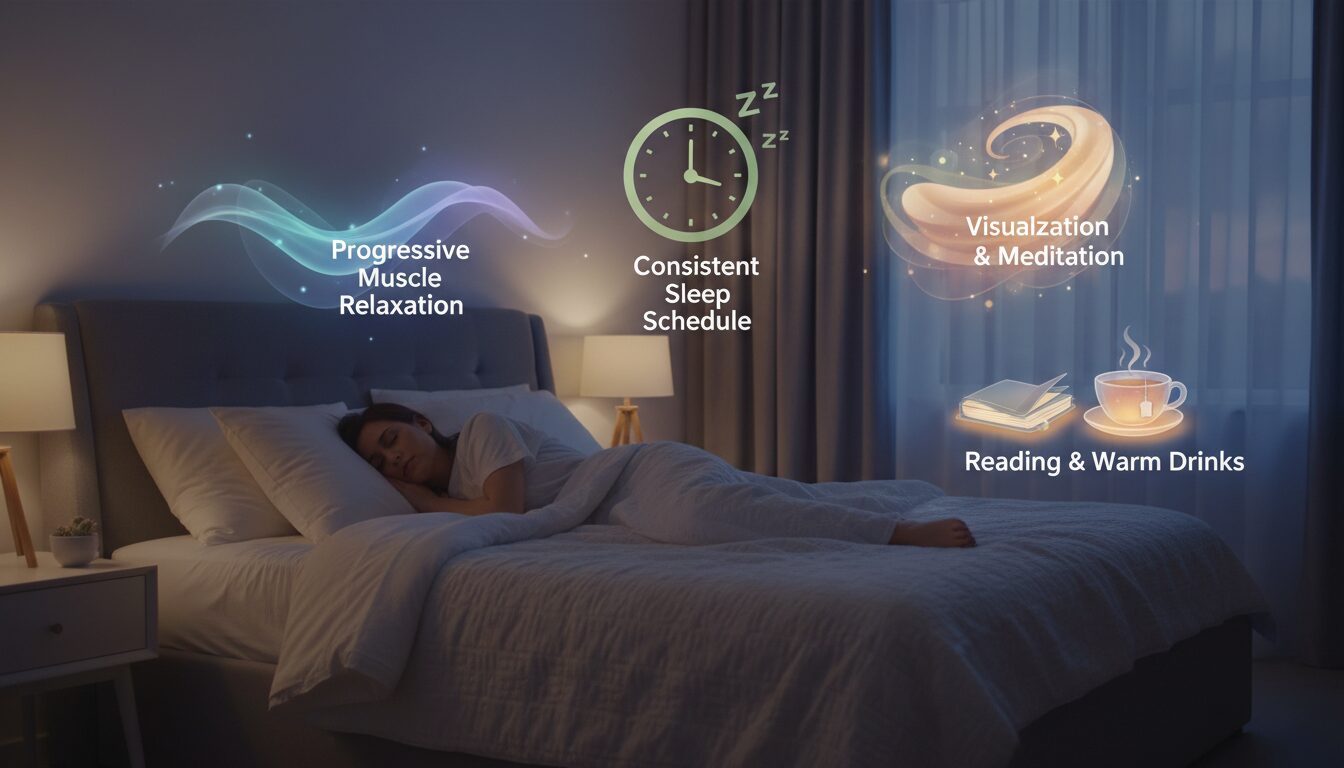
One of the primary obstacles to sleep is “cognitive hyperarousal”—the phenomenon where your mind begins a cycle of analytical thinking, planning, or worrying as soon as you lie down. To counteract this, clinical psychologists recommend the “Cognitive Shuffle” or Serial Diverse Imagining (SDI).
The Cognitive Shuffle works by scrambling the brain’s attempt to engage in coherent, linear thought. When you engage in this technique, you visualize a sequence of random, neutral objects. For example, you might think of a “Bird,” then a “Bridge,” then a “Book.” This mimics the fragmented, non-linear thoughts that occur during the hypnagogic state (the transition between wakefulness and sleep). By providing the brain with low-effort, non-threatening imagery, you signal to the cortex that it is safe to disengage.
Another potent technique is “Paradoxical Intention.” Research has shown that the effort spent trying to fall asleep actually increases arousal. When you apply paradoxical intention, you lie in bed with your eyes open and give yourself the instruction to “stay awake as long as possible.” This removes