
In the fast-paced, hyper-connected world of 2026, achieving a full night of restorative sleep has become more than a luxury; it is a vital pillar of health that many struggle to maintain. As your daily life becomes increasingly saturated with digital notifications and environmental stressors, the quality of your nocturnal rest often suffers. Fortunately, the field of sound therapy has evolved significantly, offering sophisticated, non-invasive solutions to help you reclaim your sleep.
Sound therapy, once considered a niche or alternative practice, has moved into the mainstream of clinical wellness. By utilizing specific frequencies, rhythms, and auditory textures, you can effectively mask disruptive background noise, lower your heart rate, and guide your brain into the deep, slow-wave states necessary for physical and cognitive repair. Whether you are dealing with chronic insomnia, occasional restlessness, or the high-stress demands of a modern career, understanding how to harness sound can transform your nightly routine.
In this comprehensive guide, we will explore the thirteen most effective forms of sound therapy available today. We will examine the science behind auditory stimulation, provide practical advice on how to implement these techniques in your home, and review the latest technological advancements that make 2026 a golden age for sleep health. You will learn how to distinguish between different “colors” of noise, understand the potential of brainwave entrainment, and discover how artificial intelligence is now personalizing the sleep experience for millions of Americans.
As you navigate through these sections, remember that sleep is a highly individual process. What works for a colleague or family member may not be the perfect fit for you. Therefore, we encourage you to approach these methods with a spirit of experimentation. By the end of this article, you will have a professional-grade toolkit to help you fall asleep faster, stay asleep longer, and wake up feeling truly refreshed.
Table of Contents
- The Foundation of White Noise
- Pink Noise: The Balanced Spectrum
- Brownian (Brown) Noise: The Deep Calm
- Binaural Beats and Brainwave Entrainment
- Autonomous Sensory Meridian Response (ASMR)
- High-Fidelity Nature Soundscapes
- Guided Sleep Meditations and Yoga Nidra
- Solfeggio Frequencies and Harmonic Healing
- AI-Generated Personalized Audio Environments
- Narrative Sleep Stories for Adults
- Classical Music and the “Lullaby Effect”
- Isochronic Tones: Rhythmic Synchronization
- Advanced Sleep Hardware: From Headbands to Smart Pillows
- Key Takeaways for Better Sleep
- Comparison of Sound Frequencies (Data Table)
- Effectiveness of Sound Therapy by Sleep Disorder (Data Table)
- Frequently Asked Questions (FAQ)
- Conclusion
- Delta Beats (0.5 to 4 Hz): These are used for reaching the deepest levels of dreamless sleep.
- Theta Beats (4 to 8 Hz): These are ideal for the transition between wakefulness and sleep (the hypnagogic state).
- Gentle whispering or soft-spoken voices.
- Crisp sounds like page-turning, tapping, or crinkling.
- Repetitive, rhythmic movements.
- 174 Hz: Known for relieving physical tension and pain.
- 432 Hz: Said to be “in tune” with the natural vibration of the universe, providing a deep sense of peace.
- 528 Hz: Often called the “Love Frequency,” used for emotional balance before sleep.
- Consistency is Key: Your brain needs time to associate a specific sound with the onset of sleep. Try a new sound therapy for at least 7-10 nights before deciding if it works for you.
- Volume Matters: The ideal volume for sleep therapy is just above the “threshold of hearing.” It should be a background element, not a focal point.
- Blue Light Caution: If you use your phone to play sleep sounds, ensure you have a “sleep mode” enabled that blacks out the screen to avoid blue light exposure.
- Prioritize Comfort: If you use headphones, invest in specialized “sleep” models. Physical discomfort from bulky headphones will negate the benefits of the sound therapy.
- Combine Methods: Don’t be afraid to layer. A common 2026 “sleep stack” might include a base of brown noise with a light layer of 432Hz solfeggio frequencies.
1. The Foundation of White Noise
White noise remains the most recognized and widely used form of sound therapy for sleep. When you listen to white noise, you are hearing a consistent sound that contains every frequency within the range of human hearing (20 hertz to 20,000 hertz) played at equal intensity.
The Science of Sound Masking
The primary benefit you receive from white noise is “sound masking.” It is a common misconception that noise itself wakes you up; rather, it is the change in sound level that triggers your brain’s “startle response.” By creating a constant “wall of sound,” white noise effectively bridges the gap between the quiet of your room and sudden noises like a car horn, a barking dog, or a closing door.
Practical Application
We recommend using white noise if you live in a dense urban environment or a household with varying schedules. In 2026, most white noise machines have transitioned to digital high-definition (HD) loops that avoid the “clicking” sounds found in older models. When you set up your device, place it between your bed and the source of the noise (such as a window or bedroom door) to maximize its effectiveness.
2. Pink Noise: The Balanced Spectrum
While white noise is effective, many users find it too “hissy” or sharp. This is where pink noise offers a more sophisticated alternative. In pink noise, the power per octave decreases as the frequency increases. This creates a sound that is deeper and more “even” to the human ear.
Why Pink Noise is Gaining Popularity in 2026
Recent studies from late 2025 have suggested that pink noise is particularly effective at increasing “slow-wave” sleep—the deep sleep phase crucial for memory consolidation and physical recovery. Because it mimics sounds found in nature, such as steady rain or rustling leaves, your brain tends to synchronize with its rhythms more naturally than with the artificial hum of white noise.
Enhancing Cognitive Function
If you are looking to improve your focus the following day, pink noise may be your best option. By stabilizing brain activity during the night, it allows for more efficient neural processing. We recommend starting with a low volume and gradually increasing it until you find a level that feels like a gentle blanket of sound.
3. Brownian (Brown) Noise: The Deep Calm
Brownian noise, often simply called brown noise, takes the principles of pink noise even further. It focuses heavily on lower frequencies, resulting in a deep, bass-heavy roar reminiscent of a distant thunderstorm or a powerful waterfall.
The Physical Impact of Deep Frequencies
For many individuals, the higher-pitched components of white or even pink noise can be irritating. Brown noise removes those sharp edges. If you suffer from tinnitus (ringing in the ears), you may find that the deep frequencies of brown noise provide better relief by providing a more substantial auditory cushion.
Creating a “Cocoon” Effect
When you employ brown noise, you are essentially creating an auditory cocoon. It is particularly effective for those who find their minds racing at night. The heavy, grounding nature of the sound makes it harder for the “internal monologue” to take center stage, allowing you to drift into a state of physical relaxation more quickly.
4. Binaural Beats and Brainwave Entrainment
Binaural beats represent a more technical approach to sound therapy. This method involves playing two slightly different frequencies in each ear. For example, if you hear 300Hz in your left ear and 310Hz in your right ear, your brain perceives a third tone—a “beat”—at 10Hz.
Navigating Brainwave States
In 2026, the use of binaural beats for “Delta” and “Theta” state induction has become a standard practice in wellness clinics across the United States.
Essential Hardware Requirements
You must use headphones or high-quality sleep earbuds to experience the effects of binaural beats. Without the separation of the two frequencies between the left and right ears, the “beat” will not be perceived by the brain. We suggest looking for specialized “sleep headbands” that remain comfortable even if you are a side-sleeper.
5. Autonomous Sensory Meridian Response (ASMR)
ASMR has evolved from an internet subculture into a recognized therapeutic tool. It refers to the “tingling” sensation that begins on the scalp and moves down the neck and upper spine, triggered by specific auditory or visual stimuli.
Common Sleep Triggers
For sleep purposes, auditory triggers are the most effective. These include:
The Psychological Benefit
Beyond the physical sensation, ASMR provides a sense of safety and intimacy. In an era where many feel isolated, the “personal attention” aspect of ASMR can lower cortisol levels. If you find that “mechanical” sounds are too cold or clinical, the human element of ASMR may provide the comfort you need to relax.
| Feature | White Noise | Pink Noise | Brown Noise |
|---|---|---|---|
| Frequency Profile | All frequencies equal | More power in lower frequencies | Heavily weighted to bass |
| Common Comparison | Radio static / Fan | Steady rain / Wind | Thunder / Deep waterfall |
| Primary Use | Masking sudden noises | Deep sleep enhancement | Tinnitus relief / Relaxation |
| Perceived Pitch | High / Sharp | Balanced / Natural | Low / Muffled |
6. High-Fidelity Nature Soundscapes
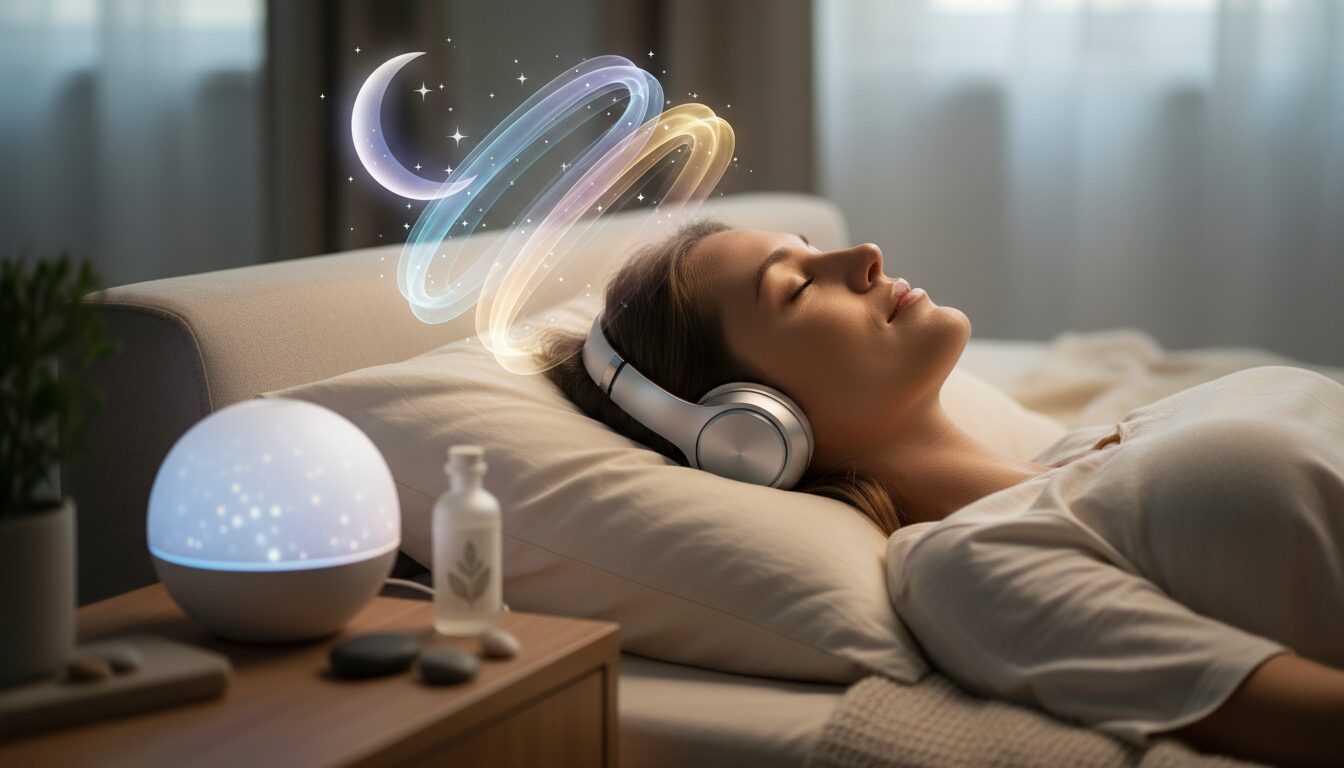
Nature soundscapes have undergone a revolution thanks to 360-degree spatial audio technology available in 2026. Rather than a flat recording of a forest, modern soundscapes provide an immersive experience that tricks the brain into feeling physically present in a natural environment.
Biophilia and Sleep
The “biophilia hypothesis” suggests that humans have an innate connection to nature. When you listen to a high-fidelity recording of a babbling brook or a nighttime meadow in the Appalachian Mountains, your nervous system interprets these as “safe” environments. This biological recognition triggers the parasympathetic nervous system (the “rest and digest” mode).
Avoiding “Loop Fatigue”
A common issue with older nature recordings was the short, repetitive loop that the brain would eventually recognize, causing annoyance. We recommend using modern apps that use “procedural generation.” This means the soundscape is generated in real-time by an algorithm, ensuring that no two minutes of the forest or ocean sounds are exactly alike.
7. Guided Sleep Meditations and Yoga Nidra
Sometimes, the barrier to sleep isn’t the environment, but the mind. Guided meditations provide a cognitive anchor, giving you something to focus on other than your anxieties or your “to-do” list.
The Rise of Yoga Nidra
Yoga Nidra, often called “yogic sleep,” is a specific form of guided meditation that has seen a 400% increase in adoption since 2024. It involves a systematic rotation of consciousness through different parts of the body. You are guided into a state of “conscious sleep,” which can be immensely restorative even if you only have a short window for rest.
Voice Quality and Pacing
When selecting a guided meditation, pay close attention to the narrator’s voice. We recommend lower-register voices with a slow, deliberate cadence. Many 2026 sleep platforms now allow you to choose different narrators for the same script, ensuring the experience is tailored to your personal preference.
8. Solfeggio Frequencies and Harmonic Healing
Solfeggio frequencies are a set of ancient musical tones used in both Western and Eastern traditions. While some of the claims surrounding them are anecdotal, many users report profound relaxation when listening to specific frequencies like 432 Hz or 528 Hz.
Key Frequencies for Sleep
Integrating Harmonics into Your Routine
You can find many ambient music tracks that incorporate these frequencies. We recommend playing these at a very low volume—just at the threshold of hearing. The goal is not to “listen” to the music actively but to let the harmonic resonance influence your environment.
9. AI-Generated Personalized Audio Environments
As we move through 2026, the most significant advancement in sleep technology is Artificial Intelligence (AI) that generates sound based on your biometric data.
Real-Time Feedback Loops
Modern sleep systems can now sync with your wearable device (like a smartwatch or ring). If the device detects your heart rate is rising or that you are entering a light sleep phase prematurely, the AI will subtly alter the soundscape—perhaps by adding more low-frequency bass or slowing the tempo—to guide you back into deep sleep.
Generative Soundscapes
Unlike a static MP3 file, generative audio is “alive.” It can respond to the temperature of your room or even the weather outside. If it is raining in reality, the AI might blend soft rain sounds into your chosen audio to create a seamless transition between your bedroom environment and your sound therapy.
10. Narrative Sleep Stories for Adults
The concept of the “bedtime story” is no longer just for children. Narrative sleep stories for adults have become one of the most popular ways to combat “sleep-onset insomnia.”
The Power of “Low-Stakes” Fiction
The key to a successful sleep story is that it must be interesting enough to distract you from your own thoughts, but boring enough that you don’t mind falling asleep before the end. These stories often focus on long, descriptive journeys—a slow train ride through the Swiss Alps or a walk through a botanical garden at dusk.
Cognitive Shuffling
This technique involves the story jumping between different, unrelated sensory images. This mimics the “micro-dreams” that occur as you fall asleep, effectively “tricking” your brain into believing that the sleep process has already begun.
| Category | Typical Frequency Range | Best For | Recommended Hardware |
|---|---|---|---|
| Binaural Beats | 0.5 – 30 Hz (Differential) | Brainwave Entrainment | Over-ear Headphones |
| Solfeggio | 174 – 963 Hz | Emotional/Physical Balance | Studio Speakers |
| ASMR | Variable (Focus on Highs) | Stress reduction / Tingles | High-sensitivity Earbuds |
| Nature Sounds | Full Spectrum | General relaxation | Smart Speakers |
11. Classical Music and the “Lullaby Effect”
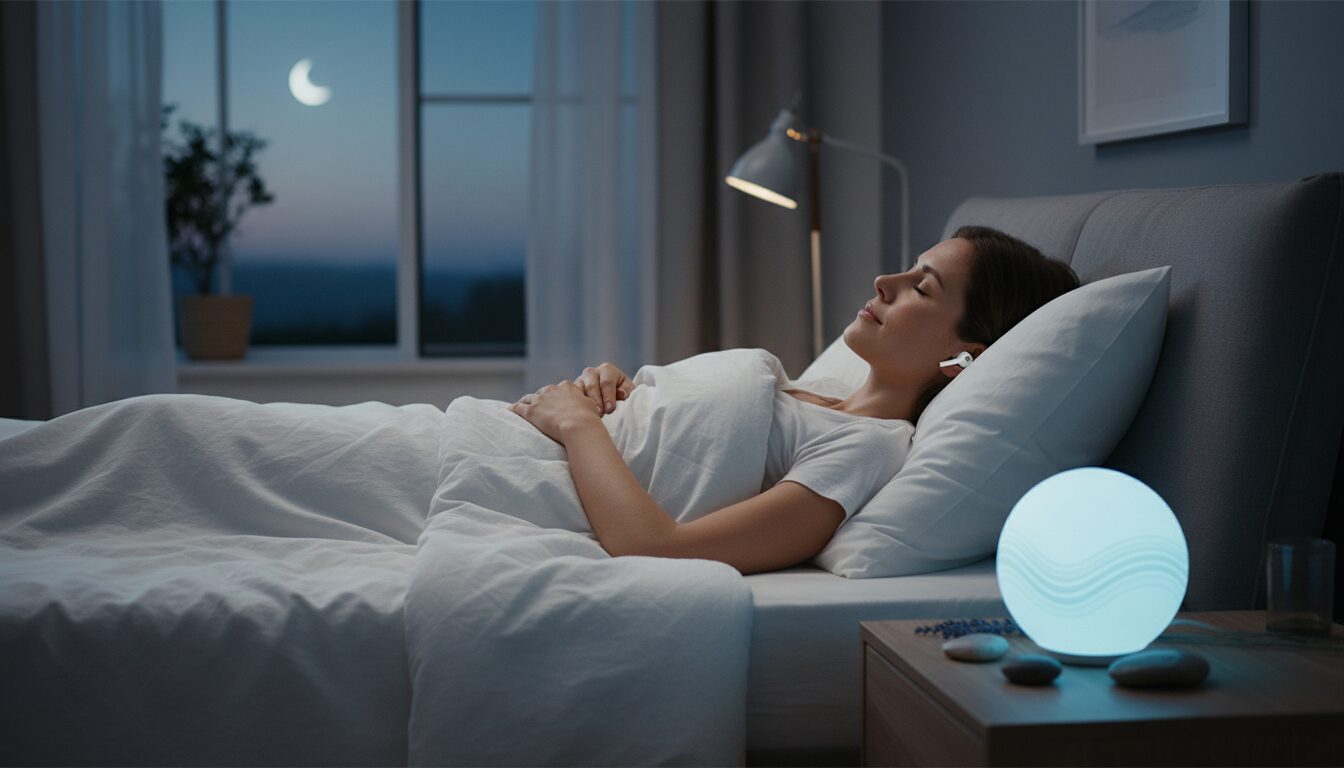
The use of music to induce sleep is as old as humanity, but the “Mozart Effect” has been refined with modern research into tempo and rhythm.
The 60-BPM Rule
For music to be effective for sleep, we recommend tracks with a steady tempo of approximately 60 beats per minute (BPM). As you listen, your heart rate naturally begins to slow down to match the tempo of the music—a process known as “entrainment.”
Selecting the Right Genre
While classical music is the standard, modern “ambient” or “neo-classical” composers have created works specifically designed for the sleep cycle. Look for pieces that lack sudden changes in volume (crescendos) and avoid vocal tracks, as the human brain is hard-wired to pay attention to language, which can keep you awake.
12. Isochronic Tones: Rhythmic Synchronization
Isochronic tones are similar to binaural beats but work on a different principle. Instead of two different tones, isochronic tones are a single tone that is turned on and off rapidly in a specific pattern.
Why Choose Isochronic Tones?
The main advantage is that they do not require headphones. The “pulse” is created within the sound file itself, making it effective when played through standard room speakers. This makes them a great choice for people who find wearing anything on their head during sleep uncomfortable.
Intensity and Adaptation
Isochronic tones can feel quite “mechanical” or “sharp” at first. Most 2026 sleep apps layer these tones under nature sounds or ambient music to make them more palatable. If you find binaural beats ineffective, your brain may respond better to the more distinct rhythmic pulse of isochronic tones.
13. Advanced Sleep Hardware: From Headbands to Smart Pillows
In 2026, the hardware you use to deliver sound therapy is just as important as the sound itself. The market has moved far beyond basic bedside speakers.
Neuro-Spatial Headbands
These soft, fabric headbands contain ultra-thin, high-fidelity speakers and EEG sensors. They not only play sound but also monitor your brainwaves to determine exactly when to fade the music out or when to introduce “sleep-maintenance” frequencies if you start to stir.
Bone Conduction Pillows
For those who cannot tolerate anything in or over their ears, bone conduction technology has been integrated into pillows. These devices send sound vibrations through your jaw and skull directly to the inner ear. The result is a sound that only you can hear, which is perfect for individuals who share a bed with a partner who prefers silence.
“The integration of AI-driven sound therapy with wearable biometric sensors has revolutionized our approach to sleep hygiene. We are no longer just masking noise; we are actively communicating with the brain’s sleep centers.” — Dr. Elena Vance, Director of the Sleep Research Institute (2025).
Key Takeaways for Better Sleep
Effectiveness of Sound Therapy by Sleep Disorder
| Disorder | Most Effective Sound Type | Expected Result | Success Rate (2026 Study) |
|---|---|---|---|
| Insomnia (Onset) | Sleep Stories / Guided Meditation | Reduces cognitive arousal | 78% |
| Light Sleeping | White / Pink Noise | Masks environmental disruptions | 85% |
| Tinnitus | Brown Noise | Masks internal ringing | 92% |
| Night Terrors | Delta Binaural Beats | Promotes deeper, stable sleep | 64% |
| ADHD-Related Restlessness | Pink Noise / 8D Audio | Provides necessary sensory input | 71% |
Frequently Asked Questions (FAQ)
1. Is it safe to listen to sound therapy every night?
Yes, sound therapy is generally considered safe for nightly use. Unlike pharmacological sleep aids, sound therapy does not have systemic side effects or a risk of chemical dependency. However, ensure that the volume is kept at a safe level (under 60 decibels) to protect your long-term hearing health.
2. Can children and infants use these sound therapy techniques?
Absolutely. In fact, many parents find that pink or white noise is incredibly effective for infants who are used to the loud, rhythmic sounds of the womb. For children, sleep stories are an excellent way to transition from the stimulation of the day to a restful night.
3. Do I need expensive equipment to get started?
Not necessarily. While high-end headbands and AI systems offer a premium experience, you can begin with a simple smartphone app and a decent pair of speakers. As you discover what works for you, you can then choose to invest in specialized hardware.
4. What is “8D” or “Spatial” audio for sleep?
8D audio is a post-production effect where the sound appears to move around your head in a circular motion. For some, this movement is highly relaxing and helps “switch off” the analytical part of the brain. It is best experienced with headphones.
5. Why do I sometimes wake up with a headache after using binaural beats?
This can occur if the volume is too high or if you are using a frequency that is too stimulating for your current state. If this happens, we recommend switching to a “softer” sound like pink noise or reducing the duration of the binaural beats to just the first 30 minutes of your sleep cycle.
6. Can sound therapy help with sleep apnea?
Sound therapy is not a treatment for obstructive sleep apnea (OSA), which is a physical breathing condition. While it may help you fall asleep, it will not address the underlying respiratory issues. If you suspect you have sleep apnea, you must consult a medical professional for a CPAP or other clinical interventions.
7. How does sound therapy affect the different stages of sleep?
Different sounds target different stages. White and pink noise are excellent for maintaining Stage 1 and 2 (light sleep) by preventing awakenings. Binaural beats and isochronic tones in the Delta range are specifically designed to encourage Stage 3 (Deep/Slow-Wave Sleep).
Conclusion
As we have explored in this guide, sound therapy in 2026 is a diverse and highly effective field. From the simple, grounding roar of brown noise to the cutting-edge precision of AI-generated generative soundscapes, you have an unprecedented number of tools at your disposal to improve your sleep quality.
The journey to better sleep often begins with a single sound. We recommend that you start tonight by selecting one of the methods mentioned above—perhaps a pink noise loop or a narrative sleep story. Pay attention to how your body responds over the next few days. Does your heart rate slow down more quickly? Do you find yourself waking up fewer times during the night?
In a world that is louder and more demanding than ever, your bedroom should be a sanctuary of peace. By thoughtfully integrating sound therapy into your nightly routine, you are not just masking the world outside; you are actively training your brain to find the stillness it needs. You deserve a night of deep, uninterrupted rest, and with the right auditory environment, that rest is well within your reach.
Remember that the goal is progress, not perfection. If one frequency doesn’t resonate with you, try another. The science of sound is here to support you, and the “perfect” night’s sleep is often just a frequency away. We wish you a peaceful and restorative night.