
🚨 Are you tired of waking up feeling like you’ve been run over by a tractor? We’ve all been there, tossing and turning, trying to find that sweet spot while your hip screams, “Absolutely not, buddy!” If you’re a side sleeper who is constantly battling hip agony, you are definitely not alone. It’s 2026, and we are officially ending this nighttime torture session right here, right now! 🥳
💥 Let’s face it: sleeping on your side is the gold standard for many, but when your hip starts complaining, the whole dream becomes a nightmare. Whether it’s bursitis, tendinitis, or just plain old “I’m getting older” syndrome, that dull ache can ruin your entire morning. But don’t worry, because I’ve got your back—and your hips! In this guide, we are diving deep into the absolute best strategies, gear, and hacks to make your bed feel like a cloud again. Get ready to kiss that pain goodbye and finally get the shut-eye you deserve. Let’s dive into this! 🚀
Table of Contents
- Why Your Hips Hate Your Bed
- The Ultimate Pillow Strategy for Side Sleepers
- Mattress Upgrades That Change Everything
- Stretches and Prep Work for Pain-Free Nights
- When to See a Pro
- Frequently Asked Questions
- 💯 Contoured Memory Foam: The king of knee pillows, holds your legs in place effortlessly.
- 🙌 Full-Body Pregnancy Pillows: Even if you aren’t expecting, these are legendary for side sleepers. They support your whole side from neck to ankle!
- ⚡ Cylindrical Bolsters: Great if you like to hug your pillow while you sleep.
- 🎉 Adjustable Air Pillows: Perfect for travel so you don’t have to sacrifice comfort on the road.
🛌 Why Your Hips Hate Your Bed
🤔 Have you ever wondered why your hip feels perfectly fine standing up but decides to host a rave the moment you hit the pillow? It’s all about alignment, my friend! When you flop onto your side, your top leg often collapses inward toward the mattress. This pulls your hip joint out of its neutral, happy place. Over time, that tiny bit of misalignment creates major tension in your muscles and ligaments. It’s like sleeping with a kink in a garden hose—the water (or in this case, your comfort) just doesn’t flow right. 🌊
🔥 By 2026, we’ve learned that the “sandwich effect” is real. Your pelvis is the heavy centerpiece of your body, and if it isn’t supported correctly, gravity takes over. That’s why you wake up feeling stiff and sore. Think about it: you spend roughly 7 to 8 hours a night in this position. If you aren’t dialed in, that’s 8 hours of micro-trauma every single night! 🤯
💡 Important: If your hip pain is accompanied by fever, severe swelling, or an inability to put weight on your leg, skip the home remedies and head to an urgent care center immediately. This is not the time to be a tough guy! 🚨
🧠 The Ultimate Pillow Strategy for Side Sleepers
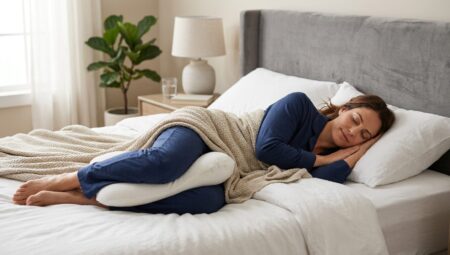
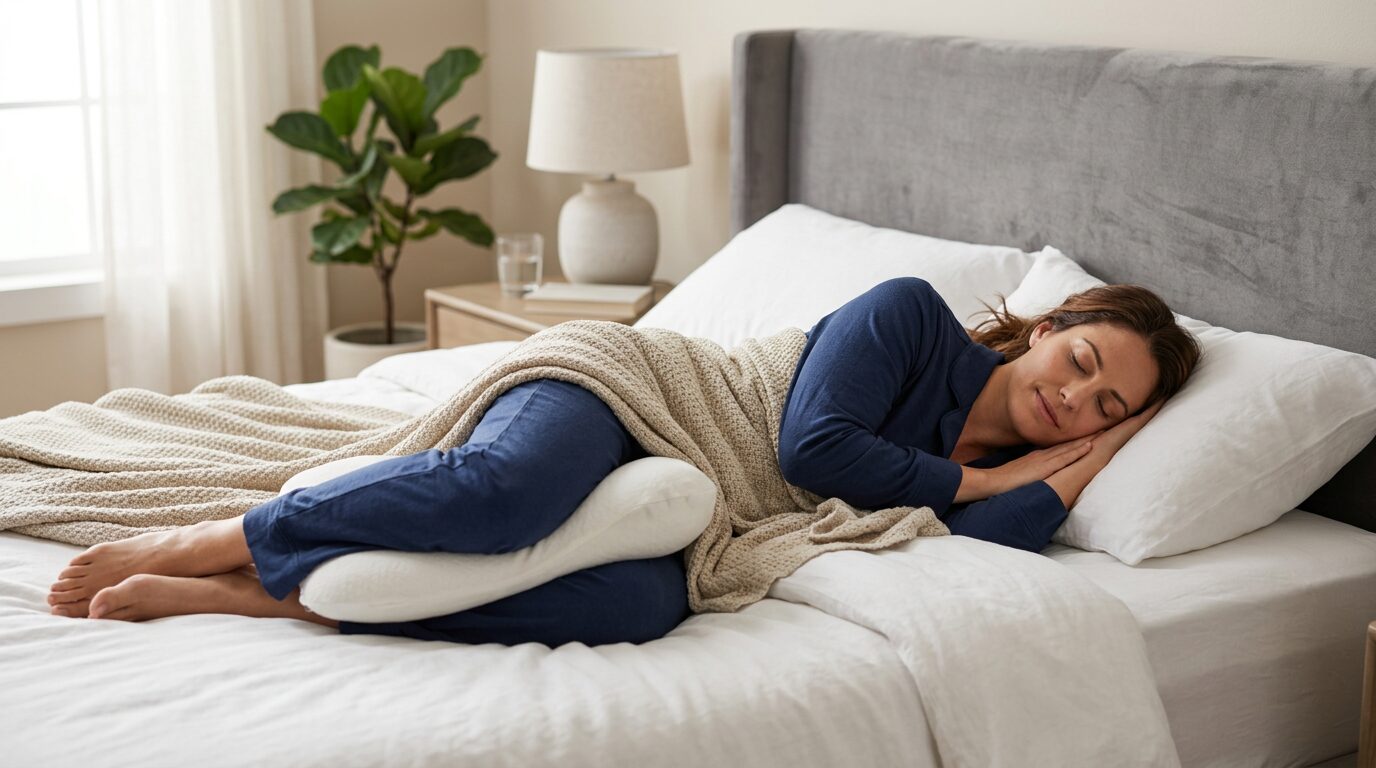
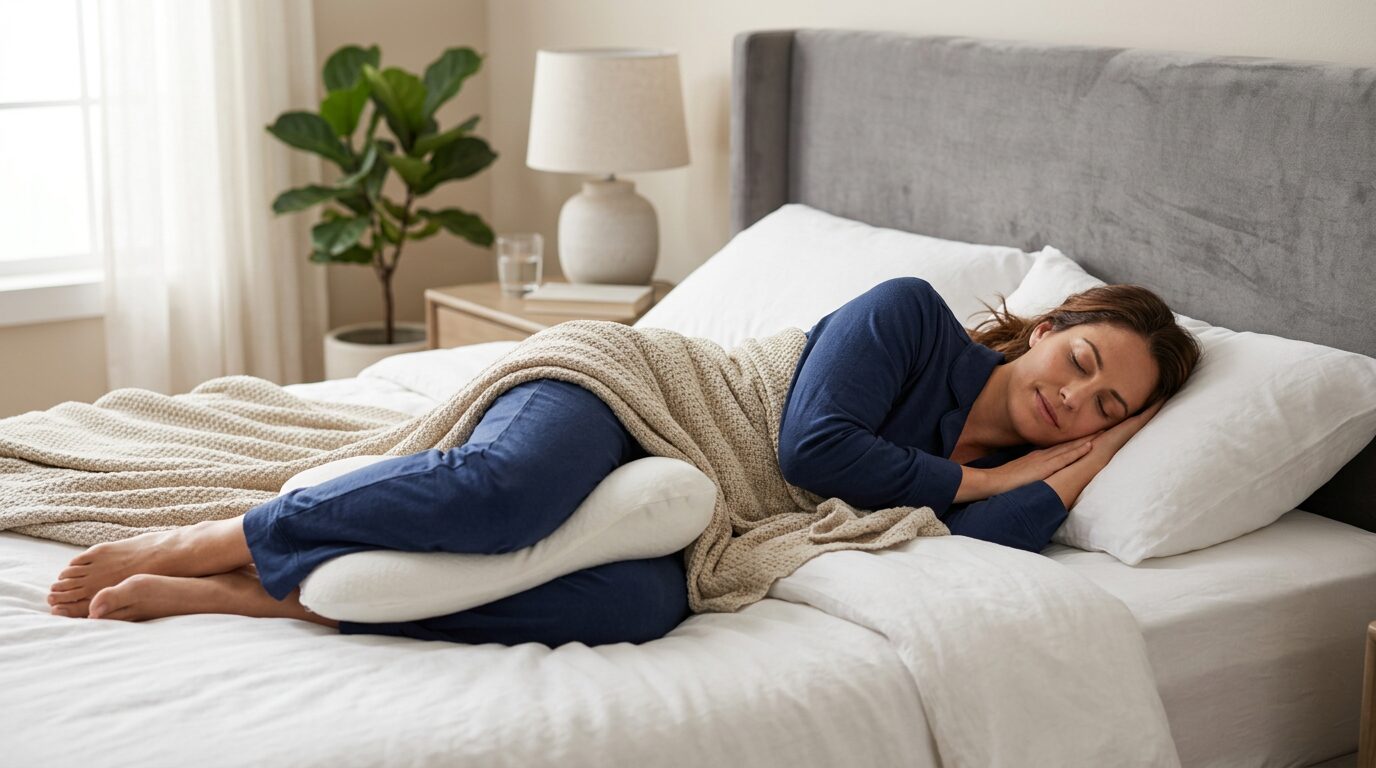
✨ If there is one magic bullet for your hip woes, it is the humble knee pillow. Seriously, stop sleeping without one immediately! Placing a firm pillow between your knees keeps your hips, pelvis, and spine in perfect alignment. It stops that top leg from sagging, which instantly takes the pressure off your hip joint. It’s a game-changer that will have you asking, “Why didn’t I do this years ago?” 💎
👑 Not just any pillow will do, though. You need something that holds its shape. If you grab a flimsy, flat cushion, it’ll be squished to nothing by midnight. Look for a contoured memory foam knee pillow. These are engineered to fit the curves of your legs perfectly, and they won’t shift around while you’re deep in dreamland. It’s all about creating that structural stability for your lower body. 🤘
⚠️ Pro-Tip: Don’t just toss the pillow between your knees. Make sure it goes all the way from your knees down to your ankles. This supports the entire lower leg chain and keeps your hip angle consistent! 🚀
💤 Mattress Upgrades That Change Everything
💸 Let’s get real for a second: if your mattress is older than your smartphone, it’s gotta go! A mattress that is too firm creates pressure points right on your hip bone, which is a one-way ticket to Bursitis City. Conversely, a mattress that is too soft acts like a hammock, sagging in the middle and throwing your spine into a pretzel shape. In 2026, we have some incredible tech that balances support and “ahh” factor perfectly. 🎯
🤩 Look for a hybrid or memory foam mattress specifically designed with “zoned support.” This means the mattress is firmer in the middle (where your hips and core are) and softer near the shoulders and feet. It’s like the mattress was custom-made for your anatomy. If you aren’t ready to drop thousands on a new bed, a high-quality mattress topper can be a life-saver. A 3-inch cooling memory foam topper can add that extra layer of cushion needed to take the edge off a hard mattress. 🌈
📉 Mattress Firmness Comparison Guide
| Mattress Type | Best For | Hip Pain Relief Level |
|---|---|---|
| Ultra-Firm | Back Sleepers | Low |
| Medium-Firm | Side Sleepers | High (Gold Standard) |
| Soft/Plush | Petite Sleepers | Medium |
| Zoned Hybrid | All Positions | Highest |
💡 Remember: Most online mattress companies offer a 100-night trial. Use it! If you don’t wake up feeling better after two weeks, return that beast and try something else. Don’t settle for back pain! 💪
🏃♂️ Stretches and Prep Work for Pain-Free Nights
🔥 You can’t just go from sitting in a desk chair for 10 hours straight to lying down for 8 hours without some maintenance. Your hip flexors are probably tighter than a drum. Before you climb into bed, take 5 minutes to do these stretches. It signals to your body that it’s time to relax, and it loosens up those cranky tendons. Your body will absolutely thank you for this ritual! 🥳
⚡ 1. The Knee-to-Chest Stretch: Lie on your back, hug one knee toward your chest, and hold. It releases the lower back and opens up the hip joint. Do both sides and feel that tension melt away. 🧘
⚡ 2. The Glute Bridge: This wakes up your posterior chain. When your glutes are weak, your hips do all the work during the day. Strengthening them before sleep helps them carry the load so your hip joint doesn’t have to. 💥
⚡ 3. Pigeon Pose (Modified): If you’re flexible enough, this is the ultimate hip opener. If not, just do a seated figure-four stretch. It hits the piriformis muscle—a notorious culprit for hip and sciatica pain. 👑
⚡ 4. Lateral Leg Lifts: Do these slowly. It engages your hip stabilizers. Think of it as “tuning” your hips before you put them into sleep mode. 🎯
🔑 Consistency is King: You don’t have to be a yoga master. Just doing 5 minutes of these moves right before bed can be the difference between waking up in agony and waking up ready to crush the day. Keep it simple, keep it consistent! 💯
🚑 When to See a Pro
👀 Look, I love home remedies as much as the next person, but sometimes you just need to call in the cavalry. If you’ve tried the pillows, the new mattress, and the stretching routine for a month and you are still crying out in pain, it’s time to talk to a doctor, a physical therapist, or a chiropractor. Persistent pain is your body’s way of saying something is structurally wrong, and you shouldn’t ignore it. 🚨
✨ Physical therapists in 2026 are absolute magicians. They don’t just treat the pain; they find the root cause. Maybe your gait is off, or maybe your core is so weak that your hips are overcompensating. They can give you a personalized plan that will fix you faster than any YouTube tutorial ever could. Don’t be afraid to invest in your health—it’s the best investment you’ll ever make! 💸
⚡ Warning: Avoid “Dr. Google” diagnostic rabbit holes. If you’re worried about your hip, get a professional opinion. It’s better to be safe and get a proper diagnosis than to guess and make things worse. Be smart, be safe, and take care of yourself! 🩺
❓ Sıkça Sorulan Sorular
❓ Is it better to sleep on my left or right side if I have hip pain?
Generally, it doesn’t matter which side you pick, as long as you have proper support! However, many people find sleeping on their left side is better for digestion. The key isn’t the side; it’s using that knee pillow to maintain alignment. Experiment with both and see which one feels more natural for you. 🤷♂️
❓ Can weight loss help with my hip pain?
Absolutely, my friend! Even shedding a few pounds can significantly reduce the force exerted on your hip joints with every step you take and every time you roll over. It’s simple physics—less load equals less stress on the joint. Combine a healthy diet with gentle movement and you’ll feel like a new person! 🍎
❓ How long should I give a new mattress before I know it works?
Give it at least 30 days. Your body needs time to adjust to new support levels. You might actually feel more sore for the first week as your muscles adapt to the new alignment. Stick it out for a month; if you’re still in pain after that, it might not be the right bed for you. ⏰
❓ Should I use a heating pad or ice pack?
It depends on the type of pain! Use ice (wrapped in a towel) for 15-20 minutes after a long, active day to reduce inflammation. Use heat before bed to relax tight muscles and soothe that deep ache. Don’t sleep with a heating pad on, though—safety first, no burns! 🔥
❓ What are the best sleeping positions if side sleeping fails?
If side sleeping is just a total no-go, try sleeping on your back with a pillow under your knees. This puts your hips in a neutral position and takes almost all the pressure off. If you are a stomach sleeper, put a thin pillow under your pelvis to prevent your lower back from arching too much. It might take some getting used to, but your hips might love the break! 😴
❓ Does my mattress age really matter?
Yes, it totally does! A mattress that’s over 8-10 years old has likely lost its structural integrity. Even if it looks okay, the internal foam or coils have likely sagged, meaning you aren’t getting the support you need. If you’re waking up sore, your bed is the first suspect I’d put on trial. ⚖️
❓ Are there specific exercises I should avoid?
If your hip hurts, avoid high-impact activities like running on concrete or jumping for a while. Stick to low-impact stuff like swimming, cycling, or walking on soft surfaces. Listen to your body—if a movement hurts, stop doing it immediately. There is a fine line between “muscle soreness” and “joint pain,” and you don’t want to cross it! 🏃♀️
🎉 Final Thoughts
🥳 You’ve made it to the end, and you are now armed with the knowledge to conquer your sleep! Dealing with hip pain isn’t just about surviving the night; it’s about reclaiming your energy and feeling like a beast during the day. Remember, it’s a journey, not a sprint. Start with the pillow, check your mattress, keep those stretches consistent, and listen to your body.
✨ You’ve got this! Don’t let a sore hip dictate your mood or your schedule. You deserve deep, restorative sleep that leaves you waking up ready to dominate the world. Now, go grab that pillow, get into bed, and get some of that sweet, sweet rest. Sweet dreams, kanka! 😴🙌